Version Control Proliferation
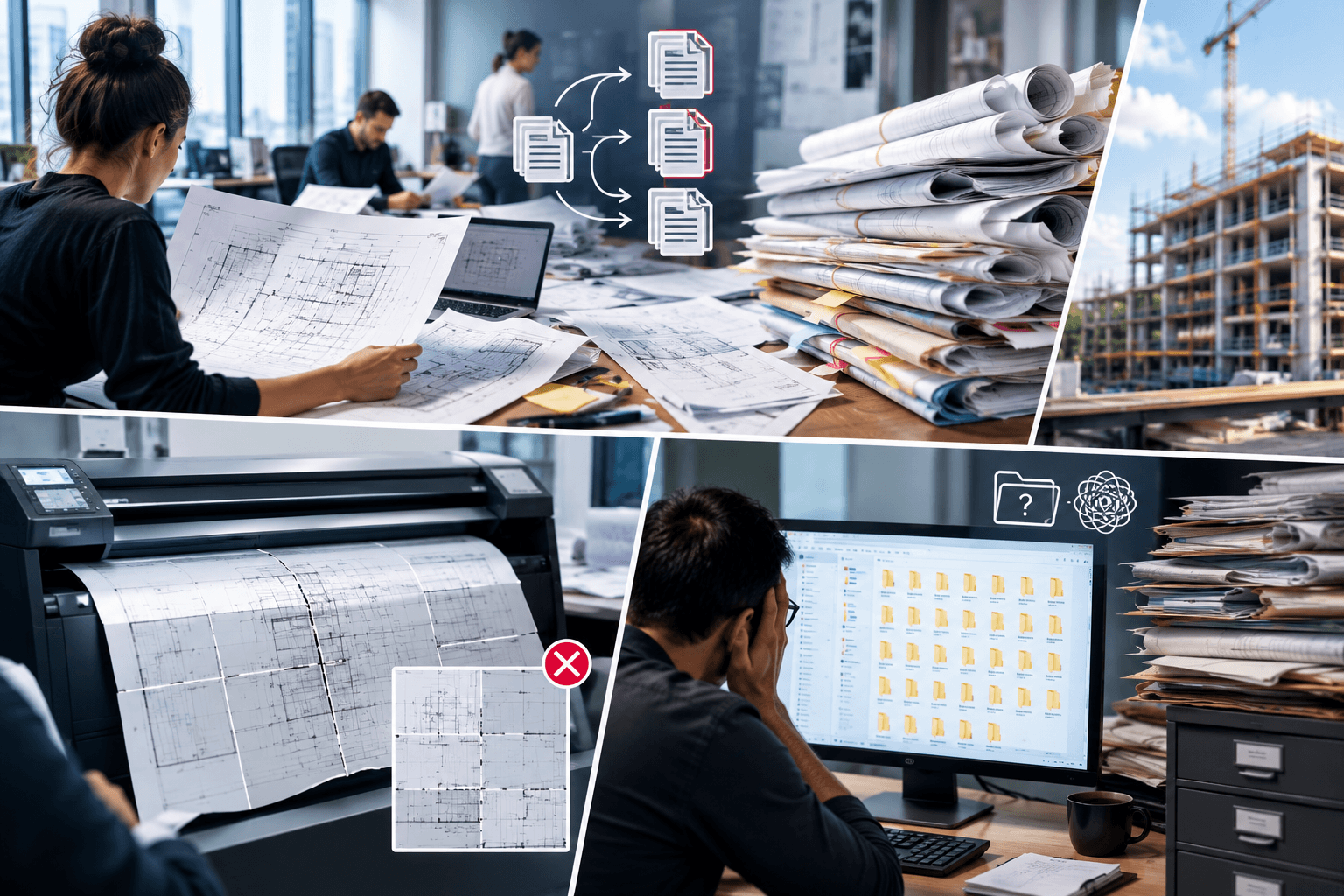
Every markup, revision and “as-built” sketch adds another paper copy to the pile. Without one single source of truth, teams work from whichever version is nearest, not necessarily the correct one.
Pitfalls of DIY Scanning
Office multifunction printers weren’t built for architectural drawing scanning. Stitched-together tiles and inconsistent resolution indicate the output is not usable beyond a quick reference copy.
The Indexing Black Hole
Without proper indexing, a digital folder can be just as difficult to navigate as a physical plan chest.
The Hidden Business and Legal Costs of Drawing Mismanagement
The cost of poor drawing management rarely appears as a single line item. It shows up scattered across budgets, timelines and compliance files instead.
The Rework Premium
Working from an outdated drawing is how a straightforward install becomes a strip-out and redo. That rework premium, in materials, labour and plant hire, eats directly into contract margin.
Handover Gridlock Risk
Practical completion stalls when O&M files and as-built drawings aren’t complete or accessible. Clients withhold sign-off, retention gets delayed, and the project drags on.
The Regulatory Threat
Under UK safety legislation, firms must produce accurate, current documentation on demand. Missing or contradictory drawings aren’t just inconvenient; they’re a compliance exposure.
Structural Data and Regulatory Realities Shaping UK AEC Operations
UK construction is being reshaped by legislation and procurement rules that assume your records are digital by default. Firms still running on paper are working against the grain of their industry.
The Golden Thread Mandate
The Building Safety Act’s “golden thread” requires an accurate, accessible digital record of a building’s design and construction information, maintained from concept through occupation. Paper archives cannot meet that standard alone.
The Modern Tender Advantage
Public and private frameworks increasingly expect digital-first information management. Document digitisation services aren’t a back-office nicety anymore; they’re becoming a prequalification criterion.
Carbon Reduction Alignment
Fewer printed sets, less courier mileage between site and studio, and reduced physical storage all contribute, modestly but measurably, to a firm’s net zero commitments.
Transitioning to Digital Clarity via Professional Large Format Scanning
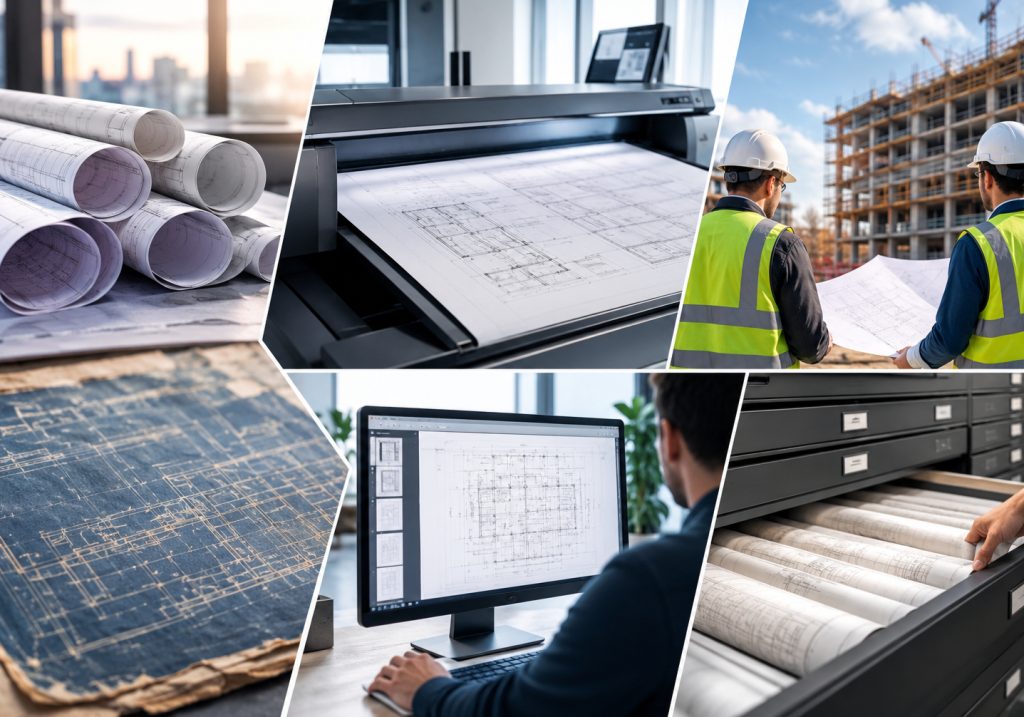
Moving to digital isn’t about owning a PDF instead of a paper roll. It changes what your drawings can do, from the detail preserved to how easily they’re found again.
Preserving Fine-Line Detail
Wide-format industrial scanners capture fine line weights and hatching that desktop equipment blurs or clips. That fidelity matters when a contractor is reading tolerances straight off the drawing.
Unlocking Intelligence via OCR
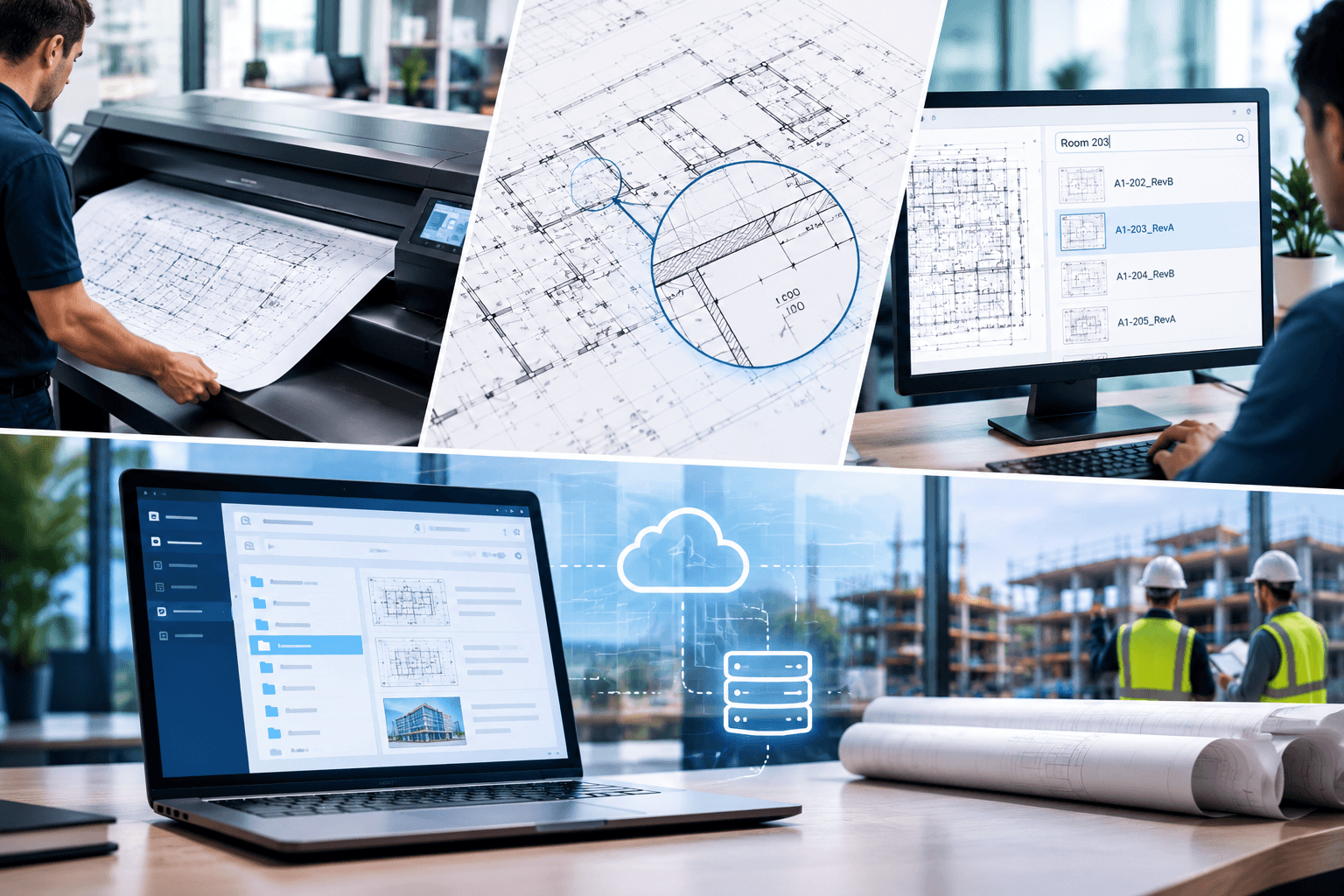
OCR converts flat images into searchable, text-indexed files. Your team can then find every drawing referencing a specific room or revision in seconds, not hours.
Seamless CDE Integration
Scanned outputs should land directly into your Common Data Environment, correctly named and structured to ISO 19650 conventions, not sit as an orphaned folder outside your project workflow.
Preparing Your Blueprints and Drawings for Scanning
A scanning project runs smoothly when the groundwork is right, not once scanning starts. These steps separate a clean, usable digital archive from an expensive stack of image files.
The Drawing Audit
Not every drawing needs the same treatment. An audit separates live, working sets from historical archive material, so budget and turnaround are matched to actual need.
Structuring the Index
Drawing number, revision, discipline, project code, date: agreeing these fields upfront is what makes a scanned archive genuinely searchable rather than just digital clutter.
Chain-of-Custody Security Protocols
Original drawings often represent decades of intellectual property. A proper chain-of-custody process, tracking, handling and secure return, protects that asset throughout scanning.
Upgrade Your Project Infrastructure with ARC UK’s Specialised Large Format Scanning Services
Every issue above, from studio-site mismatches to Golden Thread compliance, comes back to the same fix: properly digitised, indexed drawings. That’s the gap ARC UK closes for AEC teams. ARC UK provides large-format scanning services built for architects, contractors and consultants across the UK, from single archive clear-outs to ongoing construction document scanning for live sites.
We handle everything from fragile blueprint scanning services to high-volume digitisation for multi-site portfolios, indexing every drawing to metadata your team can use and delivering it straight into your CDE. Whether you need large format scanning services for UK contractors on an active programme, or large format scanning services for architects protecting a studio archive, ARC UK combines industrial-grade imaging with a process built around construction workflows, not generic office paperwork.
* – How much does field rework in construction actually cost? | ASCE