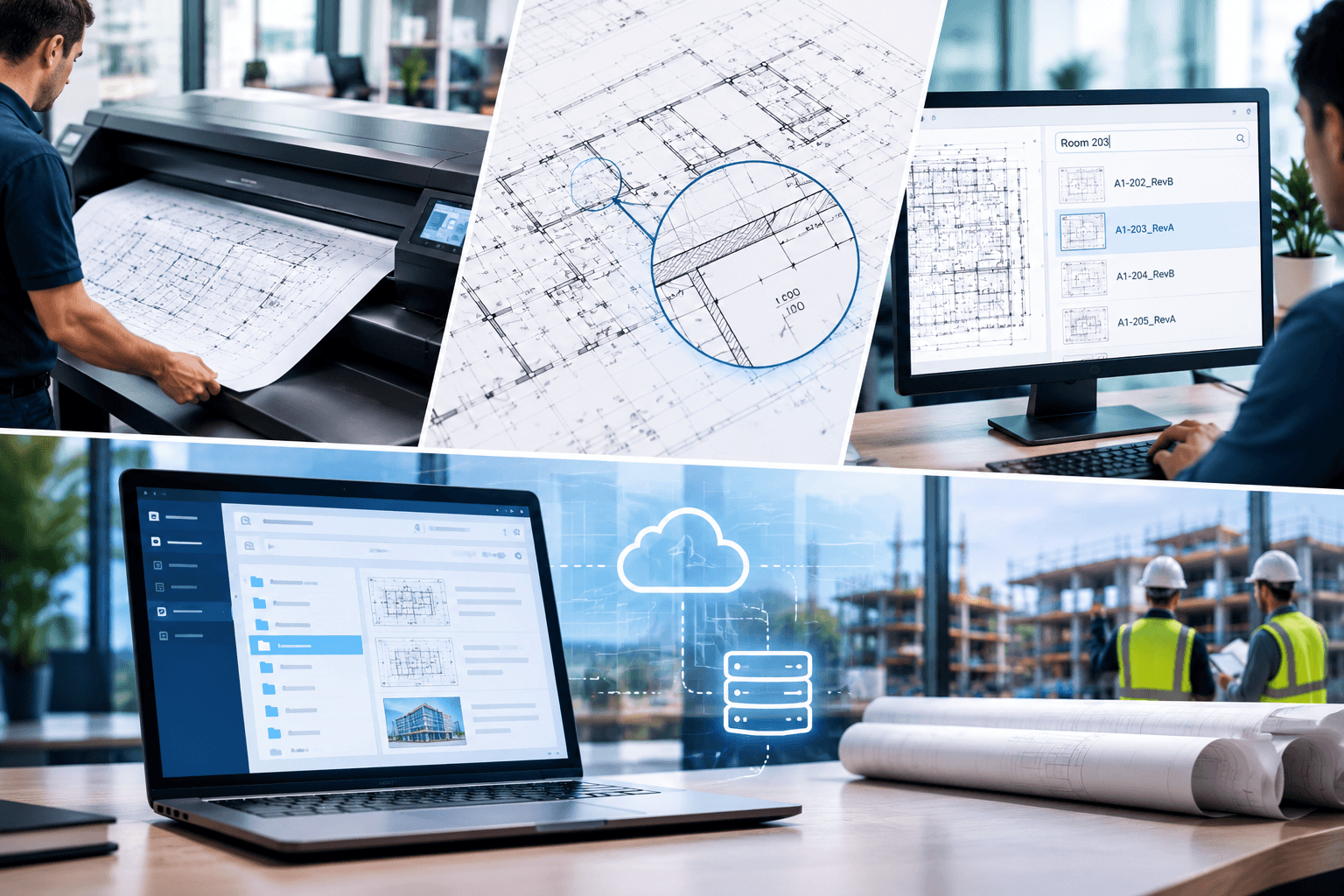
Large Format Scanning for Architects and Contractors: Managing Drawings Without the Chaos

David Roy

November 23, 2026

Transitioning to Digital Clarity Through Professional Large Format Scanning

Lost, outdated or inaccessible drawings are among the biggest contributors to costly rework on construction projects. Recent research suggests that field rework can account for an average of 0.76% of a project’s total contract value when post-completion corrections are included. On a £50 million project, that’s potentially £380,000 lost – a substantial price to pay for information that should have been readily available and properly managed*.

The financial impact goes far beyond correcting a drawing discrepancy. It results in undoing completed work, replacing materials, bringing in additional equipment and diverting valuable resources to put things right.For architects, contractors and consultants managing live construction sites alongside years of archived project documentation, disorganised information isn’t simply an administrative headache – it’s a very real threat to project budgets, timelines, and profitability.

The question isn’t whether poorly managed drawings are costing your business money; it’s how much they’re costing you, and what you could save by partnering with a Specialist Large-Format Scanning Provider to bring your project information back under control.

The Operational Reality of Managing Physical Large-Format Drawings

To understand why drawing errors cause so much disruption, look at how physical plans are managed across a project. Most firms aren’t dealing with one bad habit, but an entire physical workflow never built for how projects move today.

The Scale Challenge

A0 and A1 drawings don’t fit standard scanners, filing cabinets, or document management systems built for A4 paperwork. Firms end up storing rolls in plan chests, corridors and site cabins, nowhere near a searchable system.

Studio vs. Site Divide

The version in the studio rarely matches what’s pinned up on site. Without large document scanning and centralised access, drawing sets fork into two disconnected realities. Reliable construction document scanning keeps the studio and site working from the same version.

The Archive Decay Risk

Decades-old blueprints and dyeline plots degrade with every handling. Damp cabins and repeated unrolling accelerate the damage, and once a legacy drawing is gone, so is the record of what was built.

Root Causes of Drawing Chaos in Modern AEC Workflows

As projects become larger and more collaborative, the volume of information increases dramatically. Architects, consultants, contractors and subcontractors all generate drawings, mark-ups and revisions at different stages of delivery. Without structured information management, even small communication gaps can multiply into costly project-wide issues. Understanding the root causes is the first step towards preventing them. Drawing problems often begin with something small, such as a revised plan being saved in the wrong folder or an old copy remaining on site.

Version Control Proliferation

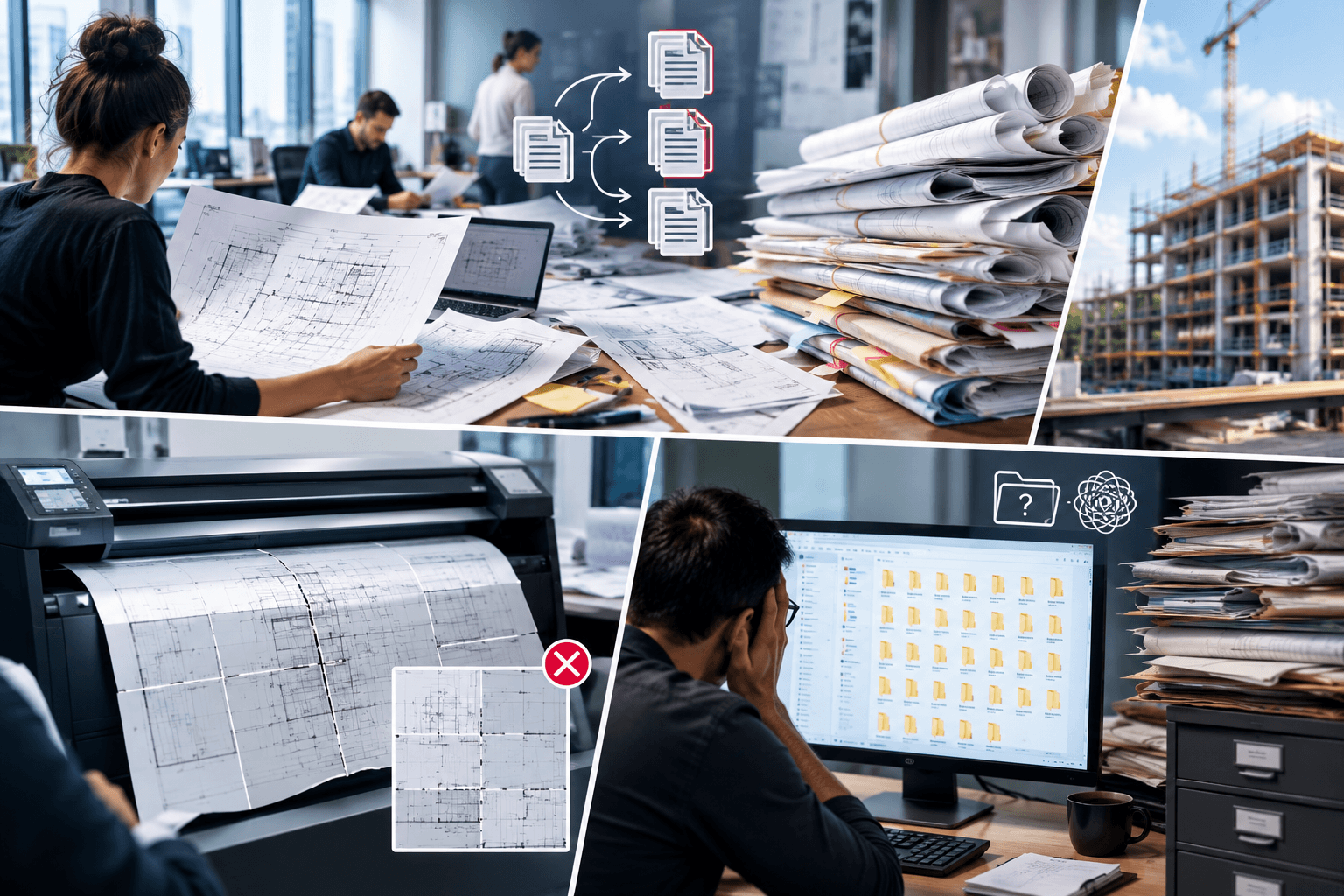
Every markup, revision and “as-built” sketch adds another paper copy to the pile. Without one single source of truth, teams work from whichever version is nearest, not necessarily the correct one.

Pitfalls of DIY Scanning

Office multifunction printers weren’t built for architectural drawing scanning. Stitched-together tiles and inconsistent resolution indicate the output is not usable beyond a quick reference copy.

The Indexing Black Hole

Without proper indexing, a digital folder can be just as difficult to navigate as a physical plan chest.

The Hidden Business and Legal Costs of Drawing Mismanagement

The cost of poor drawing management rarely appears as a single line item. It shows up scattered across budgets, timelines and compliance files instead.

The Rework Premium

Working from an outdated drawing is how a straightforward install becomes a strip-out and redo. That rework premium, in materials, labour and plant hire, eats directly into contract margin.

Handover Gridlock Risk

Practical completion stalls when O&M files and as-built drawings aren’t complete or accessible. Clients withhold sign-off, retention gets delayed, and the project drags on.

The Regulatory Threat

Under UK safety legislation, firms must produce accurate, current documentation on demand. Missing or contradictory drawings aren’t just inconvenient; they’re a compliance exposure.

Structural Data and Regulatory Realities Shaping UK AEC Operations

UK construction is being reshaped by legislation and procurement rules that assume your records are digital by default. Firms still running on paper are working against the grain of their industry.

The Golden Thread Mandate

The Building Safety Act’s “golden thread” requires an accurate, accessible digital record of a building’s design and construction information, maintained from concept through occupation. Paper archives cannot meet that standard alone.

The Modern Tender Advantage

Public and private frameworks increasingly expect digital-first information management. Document digitisation services aren’t a back-office nicety anymore; they’re becoming a prequalification criterion.

Carbon Reduction Alignment

Fewer printed sets, less courier mileage between site and studio, and reduced physical storage all contribute, modestly but measurably, to a firm’s net zero commitments.

Transitioning to Digital Clarity via Professional Large Format Scanning
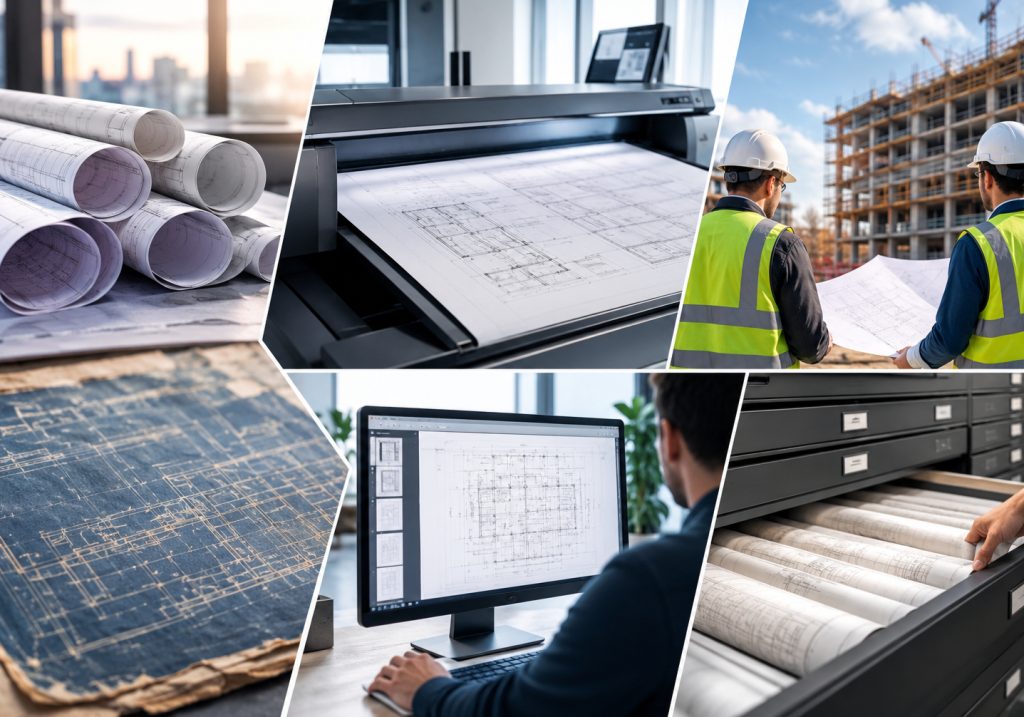
Moving to digital isn’t about owning a PDF instead of a paper roll. It changes what your drawings can do, from the detail preserved to how easily they’re found again.

Preserving Fine-Line Detail

Wide-format industrial scanners capture fine line weights and hatching that desktop equipment blurs or clips. That fidelity matters when a contractor is reading tolerances straight off the drawing.

Unlocking Intelligence via OCR

OCR converts flat images into searchable, text-indexed files. Your team can then find every drawing referencing a specific room or revision in seconds, not hours.

Seamless CDE Integration

Scanned outputs should land directly into your Common Data Environment, correctly named and structured to ISO 19650 conventions, not sit as an orphaned folder outside your project workflow.

Preparing Your Blueprints and Drawings for Scanning

A scanning project runs smoothly when the groundwork is right, not once scanning starts. These steps separate a clean, usable digital archive from an expensive stack of image files.

The Drawing Audit

Not every drawing needs the same treatment. An audit separates live, working sets from historical archive material, so budget and turnaround are matched to actual need.

Structuring the Index

Drawing number, revision, discipline, project code, date: agreeing these fields upfront is what makes a scanned archive genuinely searchable rather than just digital clutter.

Chain-of-Custody Security Protocols

Original drawings often represent decades of intellectual property. A proper chain-of-custody process, tracking, handling and secure return, protects that asset throughout scanning.

Upgrade Your Project Infrastructure with ARC UK’s Specialised Large Format Scanning Services

Every issue above, from studio-site mismatches to Golden Thread compliance, comes back to the same fix: properly digitised, indexed drawings. That’s the gap ARC UK closes for AEC teams. ARC UK provides large-format scanning services built for architects, contractors and consultants across the UK, from single archive clear-outs to ongoing construction document scanning for live sites.

We handle everything from fragile blueprint scanning services to high-volume digitisation for multi-site portfolios, indexing every drawing to metadata your team can use and delivering it straight into your CDE. Whether you need large format scanning services for UK contractors on an active programme, or large format scanning services for architects protecting a studio archive, ARC UK combines industrial-grade imaging with a process built around construction workflows, not generic office paperwork.

* – How much does field rework in construction actually cost? | ASCE

Ready to Digitise Your Construction Drawings?

FAQs

What dimensions qualify as large format scanning?

Anything beyond A4/A3, typically A0, A1 and A2 drawings, plus oversized plots, maps and plans.

Can old, torn, or delicate architectural drawings be safely scanned?

Yes, ARC UK uses careful handling protocols and non-contact imaging to capture fragile blueprints without further damage.

How do scanned drawings integrate with our existing project management software?

Files are named, indexed and formatted to slot directly into your CDE, matching your existing folder and revision conventions.

What metadata fields should we use to index our scanned construction documents?

We use various metadata fields to index your scanned construction documents including drawing number, title, revision, discipline, project code and date

Why should we outsource wide-format scanning instead of using an in-house office scanner?

In-house MFPs can’t match the resolution or throughput of industrial equipment, and outsourcing frees your team for work that’s core to their role.

What Are Your Printing Requirements?

Latest stories

Why Businesses Are Using Wall Graphics to Strengthen Brand Recognition

Most workspaces have at least one blank wall that looks complete but conveys nothing. It is painted and structurally sound. It says absolutely nothing about your business or brand. A black wall is definitely a missed opportunity. Every wall has the potential to communicate something about your brand before a conversation even begins. Physical environments […]

Read More about Why Businesses Are Using Wall Graphics to Strengthen Brand Recognition

Temporary Event Graphics vs Permanent Signage: Which Is Right for Your Business?

Have you ever wondered why some stores get maximum footfall, whereas others get zero? Poor signage graphics can be one of the reasons for getting a low impression. Surprisingly, it just takes seven seconds to form the first impression of any business or brand. Whether you run a shopping centre, retail business or launch brands, […]

Read More about Temporary Event Graphics vs Permanent Signage: Which Is Right for Your Business?

The Complete Guide to Christmas Window Graphics for UK Retailers

Key Takeaways Christmas shop window displays are the first step in your customer journey, not just decoration. The right vinyl window graphics increase footfall and strengthen festive branding. Competent artwork, standard printing, and installation give you real footfall and protect your investment in retail branding. Quick Answer: Christmas window graphics create the first impression for […]

Read More about The Complete Guide to Christmas Window Graphics for UK Retailers